

In brief
- Track FTE, not just headcount: measure booked hours against room capacity to see your true availability and protect your funding margins.
- Fix your enquiry funnel first: faster follow-ups and stronger conversion rates can increase enrolments without adding to your marketing spend.
- Turn current parents into promoters: keep families engaged and supported so they stay enrolled and recommend your nursery to others.
- Hire proactively: a full waiting list means little if you don’t have enough staff to open rooms, so use your occupancy forecast to plan recruitment early.
Every empty place in your nursery is a fixed cost with no revenue against it. It’s also one less child getting the care and early education your setting was built to provide.
For most nursery owners and managers, increasing nursery occupancy is rarely just a marketing problem. It usually comes down to four things:
- understanding what a healthy occupancy rate looks like
- turning more enquiries into enrolments
- retaining the families already in your care
- maintaining the staffing ratios needed to open every room
Most advice on increasing nursery occupancy focuses solely on marketing. This guide takes a broader view, covering the practical marketing, data and operational steps that can help you tackle all four challenges and build steady, long-term occupancy.
What’s a good occupancy rate for a UK nursery?
Before you try to fix childcare occupancy, know what you’re aiming for. Nursery sales specialist Abacus Day Nursery Sales offers 80 to 90% occupancy as a broad guide to what buyers see as healthy. Below that range, buyers usually ask more questions. Above it, the more useful question is profitability, not capacity.
Occupancy alone can be misleading. A nursery operating at 95% occupancy may still struggle if most places are funded for three- and four-year-olds, where the hourly rate is lower. Meanwhile, a nursery at 78% occupancy can be financially healthy if it has the right mix of fee-paying and funded places.
Track occupancy alongside your funding mix, not instead of it. That way, you spot low occupancy in specific rooms or session types while it’s still fixable. The target also shifts room by room, because ratios drive it.
The ratios and funding figures in this guide apply to England. Scotland, Wales and Northern Ireland set their own ratios and funded childcare, so check the rules where you are. In England, the EYFS statutory framework sets these minimum ratios:
- under-twos: one member of staff for every three children
- two-year-olds: one for every five
- three and over: one for every eight (or one for every 13 where a teacher with QTS, EYTS or EYPS is working directly with the children)
Babies need the most staff per child. A nursery-wide average can therefore hide a baby room running at capacity next to a toddler room sitting half-empty. Track occupancy room by room, not just as one headline number. Use our free nursery ratio calculator to check how many staff you need in each room.
Ratios also change what each place is worth. Baby rooms have a reputation for being the costly ones to run. Funded hours complicate that picture. Eligible working parents in England can claim funded hours from nine months, and the under-twos rate is much higher. The national average for 2026 to 2027 is about £12 an hour for under-twos, £8.90 for two-year-olds and about £6.60 for three- and four-year-olds. Your local authority’s rates will differ, so check yours.
Here’s how that plays out per child, per funded hour. The rates are DfE national averages paid to local authorities. For simplicity, we’ve assumed your local authority passes all of it on. In practice, local authorities must pass on at least 97% in 2026 to 2027, so your rate may be slightly lower.
We’ve assumed staff cost £16 an hour. That’s roughly a Level 3 practitioner paid a little above the National Living Wage (£12.71 from April 2026), plus employer National Insurance and pension.
| Funded age group | Funded rate | Staff cost per child | Left after staffing |
| Under-twos (1:3) | £12.04 | £5.33 | £6.71 |
| Two-year-olds (1:5) | £8.90 | £3.20 | £5.70 |
| Three- and four-year-olds (1:8) | £6.61 | £2.00 | £4.61 |
So a funded baby place leaves about £1 more an hour than a funded two-year-old place, and about £2 more than a funded three-year-old place. That’s despite needing more than twice the staff per child of a three-year-old place. It means an empty baby place can cost you more than an empty pre-school place.
Treat this as a guide, not a rule. Rates and staff costs vary, baby places need more floor space, and a pre-school room run at 1:13 by a qualified teacher narrows the gap.
eymanage puts the inputs for this comparison in one place. It shows FTE and occupancy room by room, and works out the staff each room needs from the children booked.
You can also allocate funded hours by funding stream, including under-twos, and record your local authority’s funding rates for revenue forecasting.
Get an accurate baseline before you try to fix anything
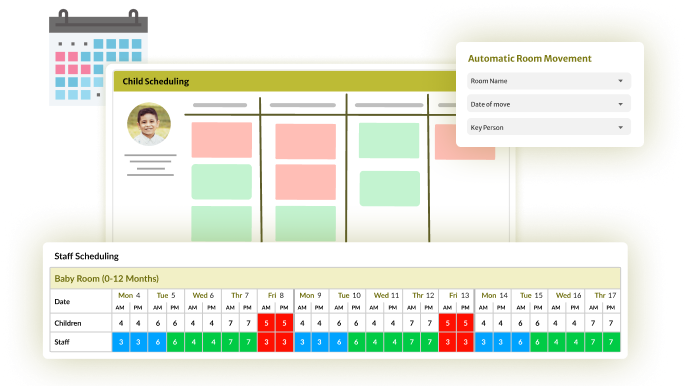
Headcount tells you how many children are on roll. Full-time equivalent (FTE) tells you how much of your capacity they use, because it counts the hours booked rather than the children.
Say a room has 20 children on roll. Ten come five days a week, and ten come two days a week. Each full-time child counts as 1 FTE, and each two-day child counts as 0.4 (two days out of five). So the room is running at 14 FTE, not 20. That’s the number that tells you whether it’s full or has space for another family.
Two nurseries can each have 40 children on roll and be at very different occupancy once you account for part-time and funded-only sessions. That’s why headcount alone is an unreliable planning number.
Nursery management software like eymanage shows this room by room, with how many children are in each room every morning and afternoon and what spaces are available. Weekly and monthly FTE and occupancy forecast reports then show where each room is heading, so you can plan ahead.
Whether you use dedicated childcare software or your own spreadsheet, review this number monthly rather than once a year. Compare each room against the same point last year, so you can tell a genuine trend from normal seasonal movement. Look at your funded and fee-paying occupancy separately too, rather than blending them into one number that hides which is under pressure.
Fix the enquiry funnel before you spend more on marketing
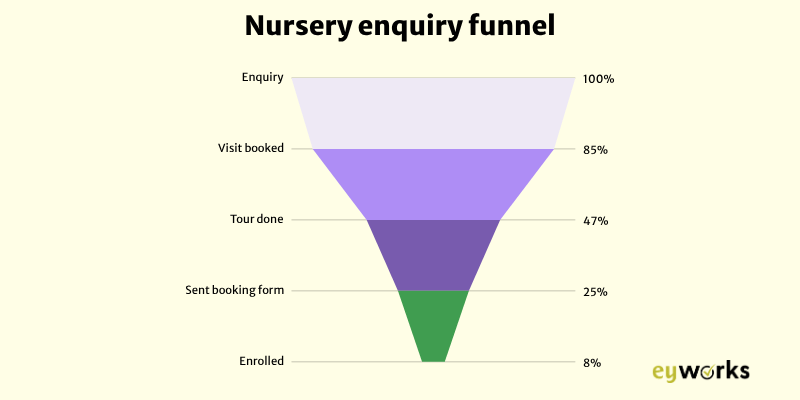
Generating more enquiries is only one part of occupancy. Enrolment of inbound enquiries is the other part of it. Think of it as a funnel.
An enquiry comes in, a visit is booked, the visit takes place, then the family registers. A small improvement at any stage can lead to meaningful occupancy growth, often without spending another pound on marketing.
Start by measuring where prospective families and prospective parents drop out. Are enquiries sitting unanswered for days? Are booked visits being missed? Are families who attend a visit choosing not to register?
A smart enquiry management tool like eyenquiries logs every stage of this journey. You can see what’s happening from first enquiry through visit booking, waitlist, and registration. It shows your conversion rates and where each family sits in the pipeline, so you can spot where families are dropping away before deciding what needs to change.
You get a pipeline view of every open enquiry, alongside a map view showing where they’re coming from geographically.
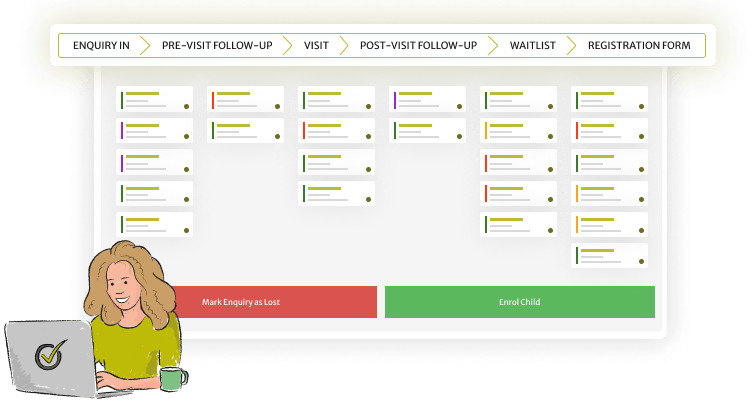
Slow follow-up is one of the most common reasons an enquiry doesn’t lead to an enrolment. Automating enquiry follow-ups means prospective families hear from you while they’re still comparing local childcare services, without relying on busy staff to remember another task. Say your visit-to-registration conversion sits at 40%. Lifting it by even ten percentage points across a term can add several enrolments without a single extra enquiry, which is a far cheaper way to grow than most paid campaigns. For more on this, see how eyenquiries helps you capture every parent enquiry.
Make prospective families choose you
Once a family makes an enquiry, first impressions decide a lot. A clean, welcoming nursery and a warm greeting from staff can matter more than any advert. A well-planned, unhurried tour also leaves a far better impression than one that feels rushed.
Your digital presence matters just as much. A nursery website should answer the questions parents are most likely to ask and make it easy to book a visit. An active, genuine social media presence and a regularly updated Google Business Profile can also influence whether a prospective family gets in touch.
Digital marketing doesn’t need a big budget to work. Keeping these channels accurate, active and consistent will usually outperform an occasional expensive campaign. A small, targeted paid social or search campaign aimed at parents looking for childcare in your immediate catchment area is often a better use of budget than boosting posts to a broad audience. Read our full guide to promoting a nursery school for practical advice on getting this right.
Local businesses are still an under-used channel for most childcare providers. Estate agents, GP surgeries, libraries, and toy shops near your setting see the same prospective families you’re trying to reach. A short partnership or a joint event can bring in enquiries a paid campaign never would. Hosting a nursery open day gives new families a low-pressure way to see your nursery in action, and a well-designed nursery brochure gives them something to take away and share with a partner or grandparent.
Across early years settings, the channel matters less than the principle: reduce the friction between someone hearing about your nursery and actually walking through the door.
Turn current families into your best source of new enrolments

The families already enrolled at your nursery can be your strongest source of new enrolments. When a parent recommends your setting to a friend, it carries more weight than any advert. They’re putting their name behind a place they trust with their own child.
Make it easy for parents to spread the word. A quick conversation at pick-up, a note in your regular parent updates or a dedicated line in your newsletter can make more difference than many nursery managers expect. You don’t need a formal referral scheme for this to work. It can be as simple as asking happy parents to spread the word.
Losing current families is just as damaging to occupancy as slow enquiries, and it gets far less attention. Consistent parent engagement, through a newsletter or regular updates on a child’s early learning and development, is what keeps families enrolled and willing to recommend you. Strong parent partnerships matter most during more difficult moments, such as settling in, a fee increase or a move to another room.
Families that feel informed and supported are less likely to look elsewhere at the first bump in the road. If you’re considering a newsletter, see our guide to creating a nursery newsletter for a practical starting point.
Don’t let staffing cap your growth
A full waiting list doesn’t guarantee you can open more places. Ratios decide how many children each member of staff can care for, so every new block of places needs staff first. If you can’t staff a room safely, those places stay empty, however strong your enquiries are.
For many nurseries, staffing, not demand, is the real ceiling. Recruitment is hard right now across the whole sector. That’s not a sign you’re doing anything wrong, but it does need the same deliberate planning as your enquiry funnel.
Staffing moves in blocks. At minimum ratio, nine babies need three staff, and a 10th needs a fourth. The 11th and 12th need no extra staff, so they’re the places most worth filling.
Start by planning hires before you need them. Check your waiting list against your ratios to see how many staff the next block of places would need.
In eymanage, weekly and monthly forecast reports show how full each room will be in the coming weeks and months. Staff ratios are worked out automatically from children’s ages and schedules. Pair the two to plan when each room will need another member of staff.
Then hire quickly, because every week a role stays open is a week those places stay empty. With eyrecruit, you post a job once and publish it to Indeed, Google for Jobs, daynurseries.co.uk, Totaljobs, and GOV.UK from one place.
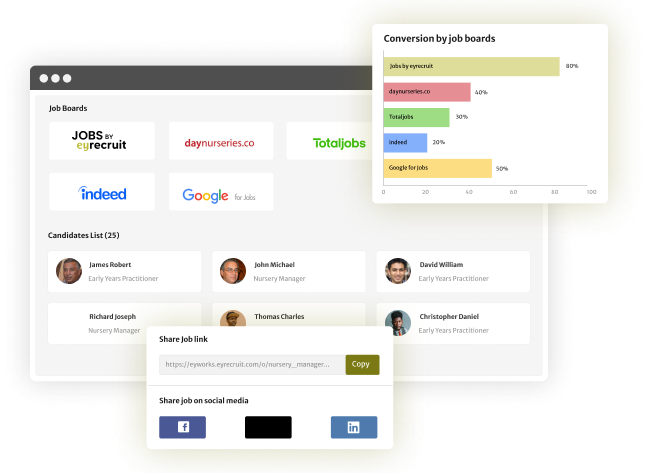
Every applicant sits in one pipeline. You can manage reference requests, right-to-work checks, and DBS status in each candidate’s profile, so a slow check doesn’t undo a fast hire.
Time-to-hire tracking shows how long hiring takes, so you can see whether it’s keeping pace with your waiting list. Review it monthly, alongside your occupancy figures.
Keep it under regular review
Increasing nursery occupancy rarely comes down to one fix. It’s the enquiry funnel, the marketing that feeds it, the current families you already have, and the staff needed to open the room. None of these levers work in isolation. A full waiting list is wasted without the staff to open a room, and a well-run funnel is wasted without families to feed it. Review all of it together, monthly, and problems get caught while they’re still small and cheap to fix.
If you want to see how nurseries use occupancy forecasting and FTE reporting day to day, book a demo and we’ll show you eymanage’s occupancy tools for your own setting.
Frequently asked questions
What is a good occupancy rate for a UK day nursery?
Nursery sales specialist Abacus Day Nursery Sales says many buyers see 80 to 90% occupancy as a healthy position for a well-run day nursery. Below that range, buyers usually want to know why, such as local competition, fees or staffing. Above it, a nursery can look attractive, but buyers will check whether it has room to grow and whether staff are stretched.
Occupancy isn’t the same as profitability, either. A nursery running full on lower-paid funded places can be under more pressure than one with a few spare places and a healthier mix of fee-paying children.
What is the difference between headcount occupancy and FTE occupancy?
Headcount occupancy measures the absolute number of children enrolled at a setting, treating a child attending one half-day session the same as a child attending full-time. FTE occupancy measures actual booked hours against total capacity. Measuring FTE occupancy provides a more accurate view of operational performance, staff utilisation, and revenue generation.
How do you calculate full-time equivalent (FTE) occupancy in a nursery?
FTE occupancy converts the hours a nursery has booked into the equivalent number of full-time children, rather than simply counting heads. A child booked five full days a week counts as 1 FTE, and a child booked two days counts as 0.4. Add these up for each room and compare the total with the room’s capacity. Nursery management software such as eymanage reports FTE and occupancy room by room, including available spaces, so you always know your real capacity rather than an approximate one.