
In brief
- The EYFS is the statutory framework for all Early Years settings in England, covering children from birth to the end of Reception.
- Learning is organised into 7 areas, designed to reflect how young children learn best through play, interaction, movement, and relationships.
- The 7 areas are split into Prime and Specific areas. The prime areas (Communication and Language, Physical Development, PSED) are the foundations for learning, while Specific areas (Literacy, Mathematics, Understanding the World, Expressive Arts and Design) build on those foundations
- Observation and assessment are about understanding how children learn, not just what they can do, using short, meaningful observations linked to EYFS areas.
- Reporting should show progress over time and inform next steps, supporting inspection readiness and strong partnerships with parents
If you run an early years setting registered with Ofsted, the Early Years Foundation Stage (EYFS) underpins everything you do. From how you set up your environment to how you plan, observe, and assess, it influences daily life for children from birth to five.
Understanding the seven areas of learning in EYFS is important for nursery practitioners. They help you plan your curriculum, track children’s progress, and give you a shared language with families.
At the same time, many early years professionals face a common challenge. How do you balance child‑led, play‑based learning with the need to observe, assess, and evidence progress without it taking over the day?
This guide will give you a clear overview of the seven areas, why they matter, how to record learning and how to talk confidently with families about children’s development. We’ll also look at how eyworks can support you to keep assessment manageable, meaningful, and firmly in the background where it belongs.
What is the EYFS framework?
The Early Years Foundation Stage is the statutory framework that sets standards for learning, development, and care for children in England.
It applies to all early years providers, including:
- nurseries and preschools
- childminders
- maintained, private, voluntary, and independent settings
- Reception classes in primary schools
The EYFS framework covers children from birth to the end of the Reception year, recognising that development is not linear and children grow at different rates.
At its core, the framework exists to help make sure children:
- Develop key skills across all areas of learning
- Are kept safe, healthy, and supported
- Are prepared for school and future learning
It also supports consistency across the sector. By setting shared expectations, the EYFS helps you work towards common goals, stay inspection-ready, and provides a structure for observation and assessment.
What are the 7 areas of learning in EYFS?
The EYFS identifies seven areas of learning and development that guide curriculum planning and assessment in early years settings.
These areas reflect how young children naturally learn. Children develop through play, interaction, movement, exploration, and relationships, not formal instruction.
The seven areas are designed to give a holistic picture of a child’s development. Progress in one area often supports growth in another.
The seven areas are grouped into two sets:
1. Prime areas of learning
2. Specific areas of learning
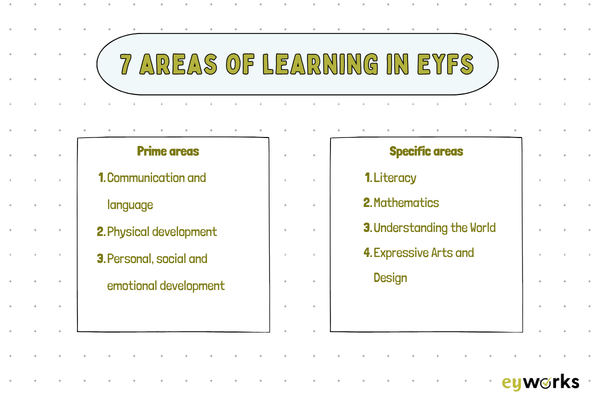
This split reflects how children typically develop in early years.
Prime areas are the building blocks. As children gain confidence and competence in these foundations, they start applying them to the more subject-based specific areas.
Prime areas of learning
The prime areas support children to build confidence, curiosity, and the skills they need to engage with the world around them.
The three prime areas are:
- Communication and Language
- Physical Development
- Personal, Social and Emotional Development
These areas are prioritised for younger children because they underpin attention, movement, emotional regulation, and relationships.
Specific areas of learning
As children grow and their prime skills strengthen, they begin to apply those skills within the specific areas.
The four specific areas are:
- Literacy
- Mathematics
- Understanding the World
- Expressive Arts and Design
These areas build on the foundations laid by the prime areas and support children’s growing curiosity, creativity, and problem-solving skills.
| Prime | Specific |
| Communication: Developing listening, understanding and spoken language. | Literacy – Building the foundations for reading and writing through stories. |
| Physical Development: Supporting growth, fine motor skills, and coordination. | Mathematics – Helping children develop number sense and pattern recognition. |
| Personal Social and Emotional Development | Understanding the World – Encouraging curiosity about how things work. |
| Expressive Art and Design – Developing creativity, imagination, and self-expression. |
Here’s a closer look at each area.
Communication and language
Communication and Language focuses on listening, attention, understanding, and speaking.
It supports children to express needs, share ideas, follow instructions, and build vocabulary through everyday interactions. It develops through conversations, stories, songs, rhymes, and role play.
Typical learning experiences and communication activities include:
- Listening to stories and responding to questions
- Taking turns in conversations
- Using new words during play
- Following simple and then more complex instructions
Practitioners might observe how a child communicates with peers, responds to questions, or uses language to explain what they are doing.
Physical development
Physical Development covers gross motor skills, fine motor skills, and health and self-care.
It includes activities that help children build strength, coordination, and control, alongside developing independence in everyday routines.
Examples include:
- Climbing, balancing, running, and jumping
- Using tools such as pencils, scissors, and cutlery
- Dressing and undressing independently
- Understanding the importance of healthy choices
The impact of strong physical development is huge, as it supports confidence, independence, and readiness for school routines.
Personal, Social and Emotional Development (PSED)
Personal, Social and Emotional Development focuses on helping children understand themselves and others.
Key themes include:
- Building self-confidence and self-awareness
- Managing emotions and behaviour
- Forming positive relationships
- Developing empathy and resilience
PSED is important because it underpins all learning. When children feel secure, valued, and emotionally supported, they’re more able to engage, explore, and learn.
Literacy
Literacy in EYFS includes early reading and writing skills, with a strong focus on foundations rather than formal outcomes.
Children develop literacy through:
- Shared reading and storytelling
- Phonics activities
- Mark-making and early writing
- Exposure to print-rich environments
The emphasis is on literacy development is about enjoyment, meaning, and confidence, rather than reading or writing fluently at an early age.
Mathematics
Mathematics focuses on numbers, numerical patterns, shapes, space, and measures.
Mathematical learning happens naturally through play, routines, and everyday problem-solving. Some maths-focused activities include:
- Counting during snack time
- Comparing quantities while building
- Exploring shapes through construction
- Talking about size, weight, and capacity
This area helps children make sense of the world through patterns, relationships, and practical experiences.
Understanding the world
Understanding the world supports children’s knowledge of people, communities, the natural world, and technology.
This includes learning about:
- Family and cultural differences
- Seasons, plants, and animals
- Past and present events
- Everyday technology
Curiosity, exploration, and questioning are central to this area, helping children develop a sense of place and belonging.
Expressive arts and design
Expressive Arts and Design focuses on creativity, imagination, and self-expression.
Children explore this area through:
- Music and movement
- Role play and storytelling
- Drawing, painting, and modelling
- Building and experimenting with materials
Encouraging expressive arts and design supports emotional expression, creative thinking, and confidence in trying new ideas.
Why are the 7 areas of learning in EYFS important?
The seven areas of learning EYFS provide a holistic view of child development, rather than focusing purely on academic outcomes.
They help practitioners:
- Plan balanced, inclusive learning experiences
- Identify children’s strengths and interests
- Spot areas where additional support may be needed
- Ensure consistency across rooms and transitions
- Evidence high-quality practice for inspections
Together, the seven areas support child-centred learning while providing a clear framework for assessment and progression. That work is guided by the four principles of EYFS, so it’s worth grounding implementation in those.
What are the four guiding principles of EYFS?
The EYFS is built around four guiding principles that shape how children are supported, taught, and cared for in early years.
Each principle is supported by a set of commitments. These turn the principles into everyday practice, helping teams stay aligned while still responding to individual children.
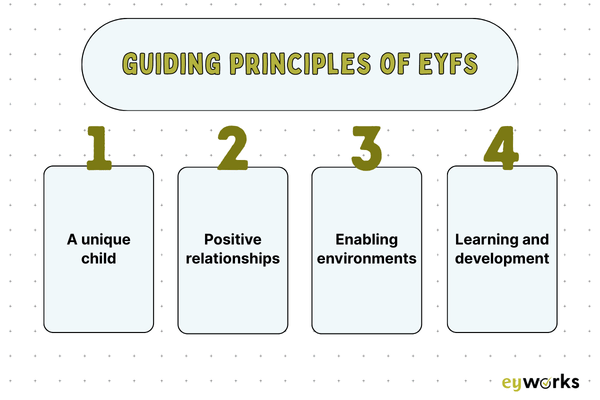
1. A unique child
Every child develops in their own way, at their own pace. The principle of a unique child recognises that children are capable, resilient, and full of potential, while also acknowledging that some may need additional support to thrive.
Key commitments include:
- Child development
- Inclusive practice
- Keeping safe
- Health and well-being
In practice, this means observations are not about comparison, but about progress for that child.
2. Positive relationships
Children learn best when they feel safe, valued, and understood. Positive relationships create the foundation for confidence, independence, and emotional development.
Key commitments include:
- Respecting each other
- Parents as partners
- Supporting learning
- The key person
Strong relationships make meaningful observation possible, because children show their real capabilities when they feel secure.
3. Enabling environments
Children learn through what they experience. An enabling environment is planned, flexible, and responsive to children’s needs, indoors and outdoors.
Key commitments include:
- Observation, assessment and planning
- Supporting every child
- The learning environment
- The wider context
Well-designed environments reduce barriers to learning and give practitioners clearer insight into how children think and learn.
4. Learning and development
Children don’t all learn in the same way, or at the same speed. This principle focuses on varied, engaging experiences that support development across all areas.
Key commitments include:
- Play and exploration
- Active learning
- Creativity and critical thinking
- The areas of learning
This principle underpins effective observation, because progress is about depth and understanding, not just ticking off milestones.
| EYFS Principle | How it looks in practice | Key commitments to follow |
| A Unique Child | You start with the child in front of you, not a “typical” child | – Child development – Inclusive practice – Keeping safe – Health and well-being |
| Positive Relationships | Strong relationships create confidence and better learning | – Respecting each other – Parents as partners – Supporting learning – Key person |
| Enabling Environments | The environment does part of the teaching | – Observation/assessment/planning – Supporting every child – Learning environment – Wider context |
| Learning and Development | Children learn in different ways, and you plan for that | – Play and exploration – Active learning – Creativity and critical thinking – Areas of learning |
How do you observe and assess the 7 areas of EYFS?
Observation in the EYFS is about understanding how children learn, not just what they can do. It helps practitioners spot patterns, interests, and emerging skills so learning experiences can be planned with purpose.
Effective observation doesn’t need to be long or complex. Short, meaningful notes captured during everyday moments are often the most valuable.
Where the best observations come from
Many of the strongest observations happen during ordinary parts of the day:
- Child-led play (indoors and outdoors)
- Routines like snack, tidy-up, arrival, and toileting
- Small-group activities and story times
- Peer interactions and conflict resolution
- Adult-child conversations in the moment
When observation becomes a separate “job” you do later, it tends to get heavier, more generic, and less accurate. When it’s embedded into daily practice, it’s more reliable and more useful.
Turning observation into assessment
Assessment comes from linking observations to the EYFS areas of learning and age-related expectations, then using professional judgement to decide what progress looks like for that child.
A practical way to frame assessment is:
- What do we know about this child right now?
- What does progress look like for them next?
- What will we do to support that?
This approach avoids checklist thinking, keeping the focus on children’s real learning rather than what’s easiest to measure.
Reporting in early years
Reporting in early years includes ongoing records, progress summaries, and transition documents. These help practitioners reflect on development over time and support smooth transitions between rooms or settings.
Sharing progress with parents is a key part of this process. Learning journals, reviews, and reports help families understand what their child is learning and how they can support it at home.
Digital tools can support this by improving consistency, saving time, and making information easier to access. Online learning journals like eylog allow practitioners to:
- Tag observations to EYFS areas
- Track progress over time
- Identify gaps or emerging needs
- Produce structured reports such as two-year checks and transition summaries
Parents can follow their child’s development through the eyparent app, receiving real-time updates, photos, and observations. Shared visibility strengthens partnerships and keeps everyone aligned around the child.
What does good EYFS observation looks like?
A helpful way to keep observations clear and purposeful is to use a simple three-step structure:
- Notice: what happened, what was said, what mattered
- Link: which area it connects to, and why
- Next: what you’ll offer next time
A good observation is specific enough that another practitioner could picture the moment, and practical enough that it leads to a clear next step.
Here are some examples of good observations for every areas of the FYFS framework, following this process above:
| EYFS Area | Vague example | Good example |
| Communication | “Leila talked about the book.” | Notice: During story time, Leila pointed to the pictures and said “He’s hiding” before the page turned. She asked, “Where did he go?” and waited for a response. Link: Communication and Language, using language to predict and ask questions. Next: Offer a small-group story with props so she can retell the plot and practise turn-taking. |
| Physical Development | “Sam used scissors.” | Notice: Sam held the scissors with his thumb on top and cut along the edge of a thick paper strip, adjusting his grip twice without support. Link: Physical Development, fine motor control and tool use. Next: Provide more cutting challenges (curves, snips) and add tweezers and peg activities to strengthen control. |
| PSED | “Arlo shared nicely.” | Notice: Arlo reached for the red car at the same time as another child. He stopped, said “You have it first,” then chose a different vehicle and returned later to ask, “Can I have a turn now?” Link: PSED, managing feelings and negotiating with peers. Next: Support small-group games with turn-taking language and visual timers. |
| Literacy | “Maya did writing.” | Notice: In the café role play, Maya wrote “tea” using a mix of letter-like shapes and a recognisable “t.” She said, “This says tea for mummy.” Link: Literacy, making meaning through marks and understanding print has purpose. Next: Add menus with photos and simple words, plus clipboards and name cards for purposeful writing. |
| Mathematics | “Omar counted blocks.” | Notice: Omar lined up cars and counted “1,2,3,4,5,” touching each car once. When asked “How many?” he said “five” without recounting. Link: Mathematics, stable order and cardinality. Next: Offer quick “how many” games at tidy-up and add counting props in small-world play. |
| Understanding the world | “Nina learned about plants.” | Notice: Outdoors, Nina noticed frost on the leaves and said, “It’s ice because it’s cold.” She rubbed it and said, “Now it’s wet.” Link: Understanding the World, noticing change and describing a simple process. Next: Set up a small investigation tray with ice and warm water, encouraging prediction language (“What will happen if…?”). |
| Expressive Arts | “Theo painted a picture.” | Notice: Theo mixed two colours and said, “It’s night sky.” He added dots with a cotton bud and told another child, “These are stars.” Link: Expressive Arts and Design, exploring materials and representing ideas. Next: Introduce different tools (sponges, rollers) and invite children to talk about their choices while creating. |
How eylog makes EYFS observation and reporting easier
EYFS observation only works long-term if it fits into the rhythm of the room. eylog is built around that reality, helping practitioners capture evidence quickly, keep assessments consistent, and share the right information with parents without turning evenings into admin time.
Here are three practical ways eylog supports day-to-day EYFS work.
1. Capture observations while you’re still in the moment
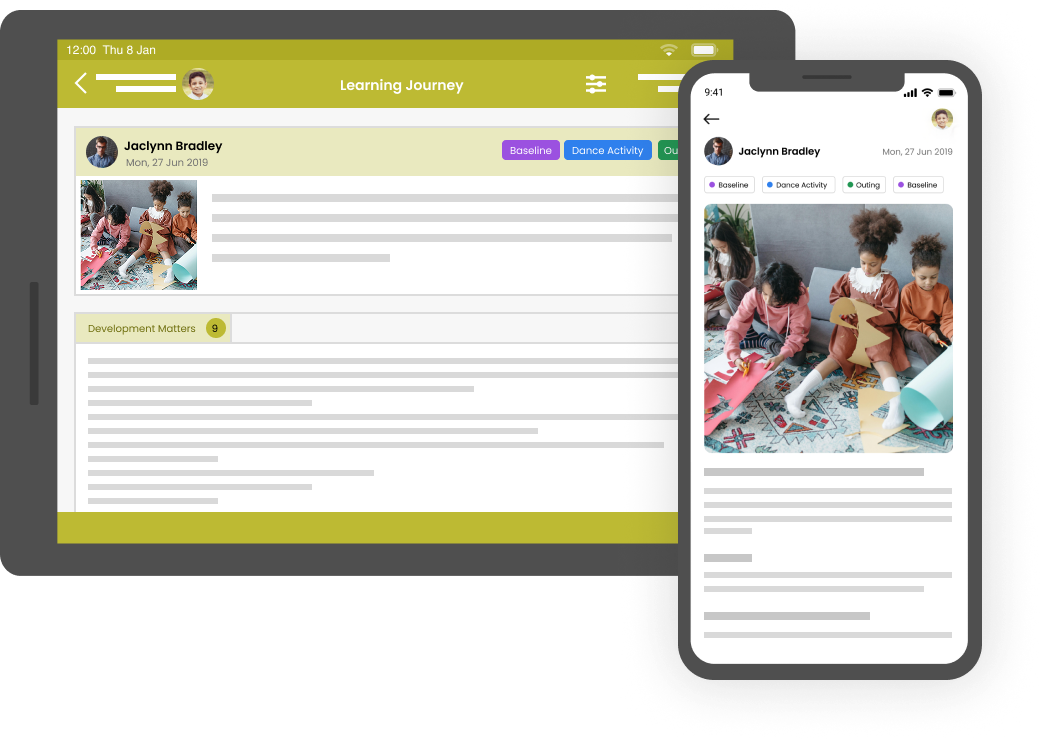
The best observations are usually the ones you record when they happen, not the ones you try to recreate later. eylog makes that easier by letting practitioners log short observations in the room using whatever fits the moment, whether that’s a photo, a quick video clip, or an audio note.
To keep things consistent across the team, staff can tag observations to the right areas of learning as they go. If your setting uses a different approach, you can work within your preferred framework instead of forcing everything into one fixed structure.
If you’re outdoors or moving between spaces, offline use means you can still capture learning and sync later.
2) Turn observations into clearer assessment and reporting
Recording is only half the job. The real value comes from stepping back and seeing what a child is showing over time, and what needs attention next.
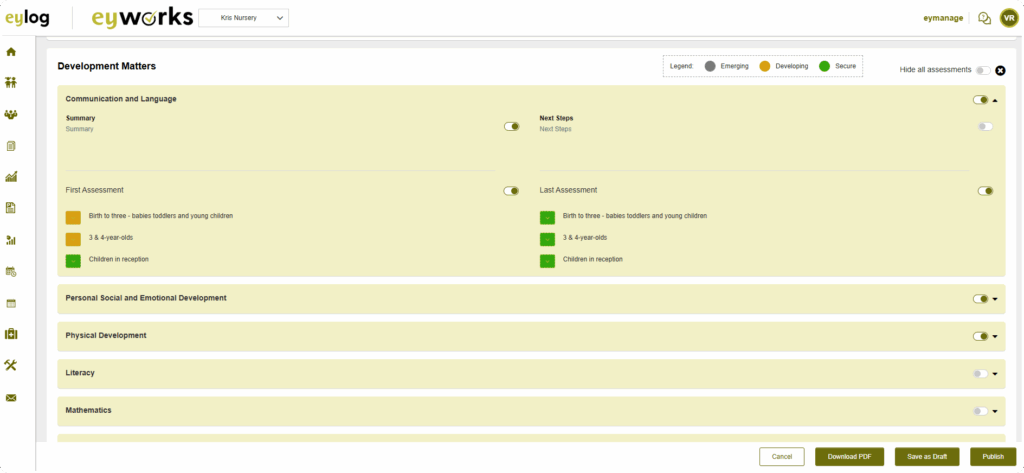
eylog keeps observations organised and easy to review. That makes assessment feel more like a clear picture, and less like a last-minute scramble through notes. Reporting becomes easier too, because you’re pulling from structured evidence rather than starting from a blank page.
Whether you’re preparing a two-year check, building a summative view, or reviewing cohorts, the focus stays on professional judgement supported by evidence, not tick-box assessment.
3) Keep families informed, and keep welfare records in one place
Carers don’t need everything. They need the right information at the right time. eylog supports flexible communication, so settings can share updates in real time, send a daily diary round-up at the end of the day, or do a mixture of both depending on what works for their team.
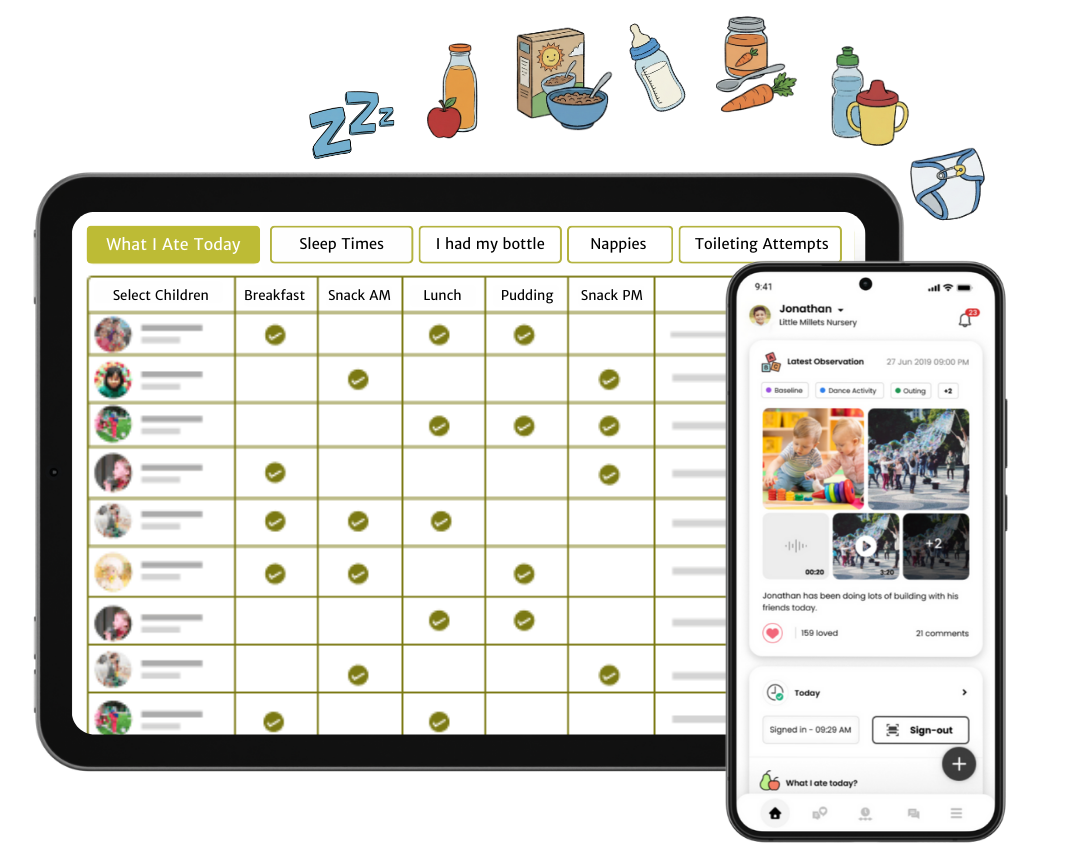
Alongside learning updates, eylog also helps keep welfare documentation organised. Daily routines, accident and incident records, and key forms can be stored digitally, so nothing disappears into a paper folder and patterns are easier to spot across a room or setting.
The result is a more joined-up picture of each child, combining learning, communication, and welfare in one place, with less admin overhead for staff.
Common EYFS observation mistakes (and how to fix them)
Even experienced practitioners can fall into habits that reduce the impact of observations. Below are common mistakes, why they matter, and how to tighten them up without creating more work.
Mistake 1: Being too vague
Vague observations don’t show learning, they just describe an activity, making it harder to assess progress and plan next steps.
Before:“Amara played with the blocks.”
After:“During free play, Amara stacked five blocks into a tower, counting aloud as she placed each one. When it fell, she said ‘too wobbly’ and rebuilt it with a wider base.”
This is better because it captures what happened, what she said, and what it suggests about the child’s thinking, in under 50 words. It also gives you options for next steps.
Mistake 2: Writing after the fact
When observations are written hours or days later, they often become generic because small details are forgotten. The note might be longer, but it’s usually less accurate.
Before (written later):“During outdoor play, Jayden enjoyed the bikes and showed confidence.”
After (captured in the moment):“Outdoors, Jayden chose the balance bike and practised pushing off three times. He said, ‘Watch me,’ then adjusted his feet and coasted past the cones without stopping.”
This change works because it’s specific, so it’s easier to assess. That makes assessment more reliable and planning more obvious.
Mistake 3: Focusing only on outcomes
Outcomes don’t show learning behaviour. Two children might both complete a puzzle, but their thinking and resilience might be very different.
Before:“Zara completed the puzzle independently.”
After:“Zara tried two pieces, noticed the shapes didn’t match, then turned one around and said, ‘This goes here because it’s curved.’ When it didn’t fit, she paused, took a breath, and tried again.”
This approach shows the thinking, language, and self-regulation. These details help you understand what’s been developed.
Mistake 4: Over-assessing everything
When you try to capture everything, you end up with more admin and less insight. The most useful evidence is selective. It shows progress, patterns, or something new.
Before:“Observed Ellie doing painting, snack, and story time today.”
After:“Focused observation: At snack, Ellie counted four grapes, then said, ‘I need one more to make five.’ She checked by touching each grape once.”
You do not need a record of the whole day. You need evidence that helps you understand development and plan next steps.
What do Ofsted inspectors actually look for?
Observing the 7 areas of learning in EYFS and reporting with an Ofsted mindset to the updated Ofsted framework helps you stay inspection-ready without creating a separate “inspection version” of your practice.
Inspectors are not looking for perfect paperwork. They’re looking for evidence that you know your children well, can explain how they’re developing, and that your curriculum and daily practice are helping children make progress.
Five things Ofsted typically wants to see
- Clear understanding of each child: Can staff talk confidently about children’s needs, interests, strengths, and next steps, supported by observations.
- Progress over time: Not one-off achievements, but a developing picture. This is where linked observations and summaries matter.
- Professional judgement: Decisions are thoughtful and child-centred, rather than driven by tick-box assessment.
- Effective use of observations: Observations inform planning, provision, and support, rather than being stored and forgotten.
- Strong partnerships with parents: Parents are kept informed, their insights are valued, and communication supports continuity between home and nursery.
Well-written observations, linked to learning and used to shape provision, make this evidence easy to demonstrate.
| What Ofsted looks for? | What to show in observations |
| Intent, implementation, impact | Short observation and what you changed next |
| Progress over time | 2-3 linked observations showing development |
| Inclusion and SEND | Adaptions, targeted support, outcomes |
| Safeguarding and wellbeing | Welfare records, patterns spotted, actions taken |
| Parterhsip with parents | Parent contributions and shared next steps |
Make reporting on the EYFS framework easy with eyworks
EYFS observation and reporting should support practice, not compete with it. eylog, as part of eyworks, helps nurseries stay compliant, confident, and focused on what matters most, the children.
With tools that support observation, assessment, reporting, and parent partnership, eyworks acts as a smart sidekick for practitioners and parents alike. Discover more about how eyworks can support you with a bespoke demo.