

In brief
- The government has announced a £4 billion investment in SEND reform alongside the “Every Child Achieving and Thriving” white paper, shifting the system towards inclusion by default.
- Early years settings will receive upfront funding through the £1.6 billion Inclusive Mainstream Fund to provide targeted support, like speech and language interventions, without waiting for a formal EHCP (Education, Health and Care Plan).
- A new digital Individual Support Plan (ISP) will be required for every child with identified SEND. No diagnosis is needed, and the ISP will follow the child from nursery to primary school.
- The £1.8 billion “Experts at Hand” service will give nurseries more routine access to specialists such as educational psychologists, speech and language therapists, and occupational therapists.
- £700 million is going to Best Start Family Hubs, plus an additional £200 million to strengthen the SEND offer within them, with a named SEND professional in every hub.
- A fast-track route alongside the NHS will be introduced for children under five with the most complex needs, getting them access to specialist support sooner.
- These are proposed reforms currently under a 12-week consultation. You can share your views until 18 May 2026.
The government has announced what it calls a generational shift in how we support children with special educational needs and disabilities. On 23 February 2026, it pledged to end the “one size fits all” education system that has, in its own words, “traumatised too many families” and “damaged the lives of too many children.”
The reforms are backed by a £4 billion investment over three years to strengthen mainstream inclusion and specialist capacity. Alongside this, the “Every Child Achieving and Thriving” white paper and the companion consultation, “SEND Reform: Putting Children and Young People First”, set out a decade-long vision for moving towards what the DfE (Department for Education) describes as “inclusion by default.”
If you’re running a nursery or early years setting, these changes will affect how you identify needs, plan support, and work with families. Here’s what you need to know and how you can start preparing.
Why early intervention is now front and centre
The DfE is prioritising early intervention as a core principle of these reforms. The government’s white paper is structured around five core principles, with “early intervention so support arrives without delay” listed first.
Instead of families waiting months (or years) for a formal EHCP (Education, Health and Care Plan), the government will invest £1.6 billion in an Inclusive Mainstream Fund over three years from 2026-27 to help early years settings, schools, and colleges become inclusive. Early years settings will receive more upfront funding so you can provide targeted support, like speech and language interventions or small-group sessions, as soon as you identify a need.
The government says this will end the longstanding issue of families having to “fight” for basic support.
How the £4 billion investment is being distributed
Here’s a breakdown of where the money is going:
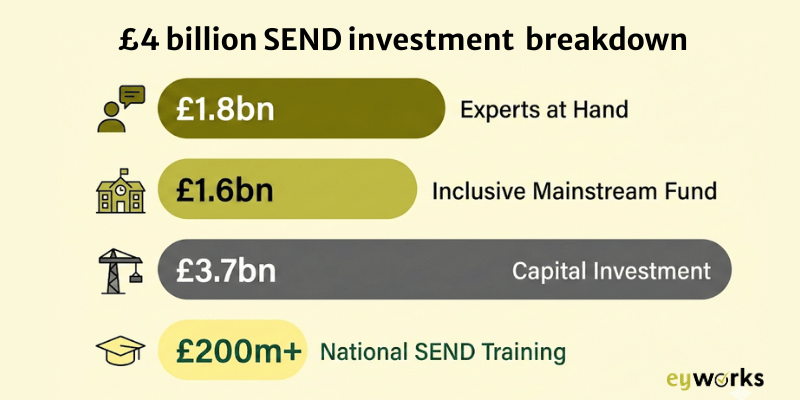
Inclusive Mainstream Fund (£1.6 billion over three years)
This fund goes directly to early years settings, schools, and colleges to help them become more inclusive. For nurseries, this means upfront funding you can use to commission evidence-based support, such as small-group oracy sessions or adaptive communication resources, without waiting for lengthy assessments.
With these additional funds, early years settings, schools, and colleges will be held accountable for delivering high-quality inclusive practice.
Experts at Hand (£1.8 billion over three years)
This creates a new national offer called “Experts at Hand”, wrapping professionals such as educational psychologists, speech and language therapists, and occupational therapists around mainstream settings.
For nurseries, this means more regular, routine access to specialist advice for the children in your care, even those without a statutory plan. The investment will ensure these experts are working with children rather than being tied up in bureaucratic processes. The government is also training an additional 200 educational psychologists each year from 2026.
National SEND training programme (more than £200 million over three years)
This is a new training programme designed to upskill all staff across early years, schools, and colleges. SEND training will be a requirement in the updated Code of Practice. The training will cover adaptive teaching, identifying barriers to learning, and creating inclusive environments.
Capital investment (£3.7 billion to 2030)
This fund covers physical accessibility upgrades, new specialist school places, and the creation of tens of thousands of new places in “Inclusion Bases” within mainstream settings. The government will publish inclusive design guidance to help local authorities and settings use their estate to support inclusion, alongside a broader Education Estates Strategy.
These four pots make up the £4 billion mainstream inclusion investment. But there’s another significant funding commitment that’s specifically relevant to nurseries and early years, which we’ll cover next.
Best Start Family Hubs: a big deal for early years
One detail that’s easy to miss in the wider headlines is the significant investment in Best Start Family Hubs. The government has committed £700 million to these hubs over the next three years, plus an additional £200 million specifically to strengthen the SEND offer within them.
Each hub will have a dedicated SEND professional. The goal is for nurseries and early years providers to work alongside these hubs to identify needs early and intervene swiftly. Evidence referenced in the consultation shows that children with access to Sure Start Children’s Centres were more likely to have their needs recognised at age five and less likely to require SEND support between ages seven and 16.
If your setting is near a Family Hub, it’s worth building that relationship now.
Individual Support Plans (ISPs): what they mean for your setting
A cornerstone of the reforms is the introduction of digital Individual Support Plans (ISPs). Children and young people won’t need to apply for a statutory plan to benefit from the Targeted and Targeted Plus layers of support. They’ll receive a new, digital ISP, provided by their early years setting, school, or college and developed in partnership with parents. ISPs will be digital, accessible, and evolve with the child.
Important note: these are proposed reforms currently under consultation. The ISP duty isn’t law yet, but the direction of travel is clear. Here’s what we know so far:
- No diagnosis required. Every setting will be required to create a digital ISP for any child with identified SEND. No diagnosis is needed to trigger this.
- Standardised and portable. Because ISPs are digital, they’ll follow the child as they transition from nursery to primary school, removing the need to start from scratch each time.
- Focus on day-to-day care. ISPs document specific barriers to learning, reasonable adjustments, and intended outcomes.
- Work alongside EHCPs. Children with EHCPs will also have an ISP setting out exactly how the package will be delivered day-to-day by their school.
Fast-track route for under-fives
Here’s something specifically relevant to nurseries: the reforms will introduce a fast-track route alongside the NHS to provide a specialist provision package and an EHCP for children under five who have been identified as having the most complex needs. This is a significant change. It means the youngest children with the highest levels of need should get access to specialist support much more quickly than under the current system.
The rollout timeline
The government is taking a careful, phased approach to implementation. The changes will be introduced across three overlapping stages. Alignment with best practice will begin from the 2025/26 academic year. Preparation for SEND and curriculum reforms will follow from 2026/27, with full implementation planned from 2028/29.
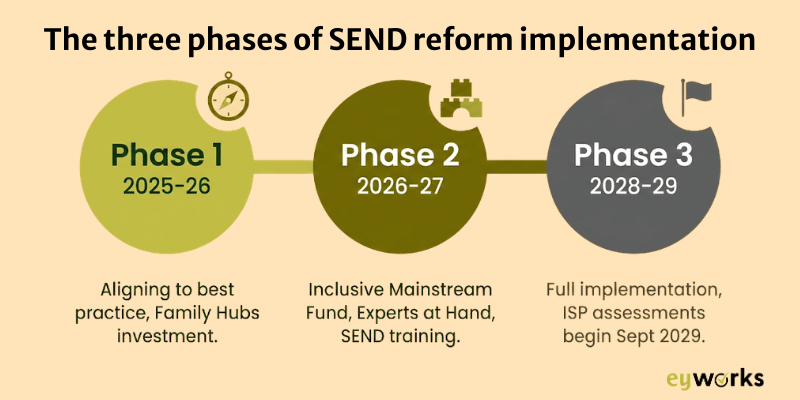
Here’s how that breaks down:
- Phase one (2025 to 2026): Standardising local offers and aligning with existing best practice. The government is already investing in Best Start Family Hubs and training more educational psychologists.
- Phase two (2026 to 2027): Rollout of the Inclusive Mainstream Fund, the Experts at Hand service, and the national SEND training programme. The updated Code of Practice and ISP framework will be prepared during this phase.
- Phase three (2028 to 2029 onwards): Full system-wide implementation. Assessments for the new system will start in September 2029, with no changes to current support before “at least September 2030”.
This is a decade-long programme. EHCPs will be reserved for the most complex needs by 2035. The transition is designed to be gradual so that no child loses support during the changeover.
Have your say on the reforms
The government has opened a 12-week consultation and wants to hear from early years professionals. The SEND proposals are still out for consultation, so the detailed legal framework hasn’t been confirmed yet.
You can share your views on the SEND reform consultation until 18 May 2026. Your voice as an early years professional matters here. The consultation specifically lists early years providers as a group it wants to hear from.
How eyworks helps you prepare for the changes
We know that more funding and new statutory duties often come with more paperwork and more complex scheduling. We’ve built our software to handle the administrative load so you can focus on the children.
- Automated ratio management. With eymanage, you can manage the higher staffing levels that inclusive care requires. When a child needs one-to-one support, mark it on their profile. The system automatically adjusts your ratio calculations, showing you how many staff you need in the room to stay compliant.
- Evidence for ISPs. Use eylog to capture daily observations and track the progress of targeted interventions. This gives you the high-quality evidence you’ll need when ISPs become a requirement for your setting.
- Staff training and compliance. The reforms introduce new inclusion training requirements. You can use eypeople to record qualifications, set training reminders, and make sure your team is ready.
- Parent collaboration. The DfE is placing a strong emphasis on co-producing ISPs with parents and carers. Use eyengage to keep families updated on their child’s progress through posts and polls, strengthening the partnership the government now expects.
What you can do right now
You don’t need to wait for legislation to start preparing. Here are some practical steps:
- Review your current SEND processes. Are you identifying needs early and documenting the support you’re providing? This is the foundation of a good ISP.
- Build relationships with your local Family Hub. If there’s a Best Start Family Hub near you, connect with the SEND professionals there.
- Audit your staff training. What SEND training has your team completed? Use this as a baseline before the national training programme rolls out.
- Respond to the consultation. The more early years voices the DfE hears, the more likely the final reforms will reflect the realities of nursery life. Submit your response here before 18 May 2026.
At eyworks, we support settings of all sizes. We’ll continue to update our software to make sure you remain compliant with the EYFS (Early Years Foundation Stage) and the latest SEND requirements.
If you’d like to see how we can help your setting manage the transition to digital support plans, book a demo with our team.