
In brief
- Risky play builds emotional resilience, confidence, and crucial physical skills in the early years. Research shows that adventurous activities can significantly lower symptoms of anxiety and depression in children.
- Changing adult language helps children build genuine risk literacy. Swap reactionary phrases like “Be careful!” for open, reflective questions that encourage children to evaluate their own safety.
- A risk-benefit assessment balances developmental rewards with real safety. It helps your setting distinguish between hidden hazards, which must be removed, and manageable challenges, which offer real learning value.
- Documenting these moments easily reassures anxious families and staff. Capturing photos and milestones through eylog helps move your setting from a paperwork-first to a presence-first mindset.
Risky play can be a contentious topic in early years. As a practitioner, you know that play that involves risk supports important development for the children in your care. You’ve likely seen firsthand the look of pride and accomplishment on a child’s face when they reach the top of a climbing frame or accomplish something difficult. But you’ve probably also faced awkward questions from parents at pick-up after they noticed a grazed knee and wanted an explanation.
The tension between these rewards and the perceived risk leads many settings avoid risky play entirely, unintentionally removing a vital developmental tool. When done right, risky play is highly beneficial for children’s development.
But before we can fully explore the practicalities, it’s important to ground the discussion by defining what we actually mean by ‘risky play.’
Risky play refers to activities that involve a sense of challenge, excitement, or uncertainty, where children test their physical and emotional limits. It includes situations where there is a possibility of minor injury, but where the learning benefits outweigh the risks.
A University of Exeter study of nearly 2,500 parents found that children aged 5 to 11 who played adventurously had significantly lower symptoms of anxiety and depression. That is not a small finding. It is the kind of evidence that should give every early years practitioner confidence to embrace risky play properly, not reluctantly.
This guide covers how to implement risky play practically, how to assess it compliantly, how to bring staff and parents with you, and why the developmental case is so strong.
How do you implement risky play in your setting?
Implementing risky play requires a deliberate shift across three core areas: the physical environment, the activities on offer, and the language educators use.
Start with the environment
Introduce risky play gradually. Start with one or two activities that feel manageable for your team, then build complexity over time as confidence grows. Settings that try to change everything at once often pull back when the first scraped knee sparks anxiety.
Good environments for risky play include:
- Natural materials and landscape: trees, logs, uneven terrain, hills, and slopes
- Balancing structures: beams, stepping stones, and balance boards
- Outdoor water and mud: water trays, mud kitchens, and natural puddles
- Simple tools: age-appropriate scissors, hammers, and garden tools
Messy play and risky play often overlap. If your setting already has a mud kitchen or water tray, you have a natural starting point. For inspiration on extending these activities, our guide to the advantages of messy play covers the developmental case in more detail.
Risky play activities to try
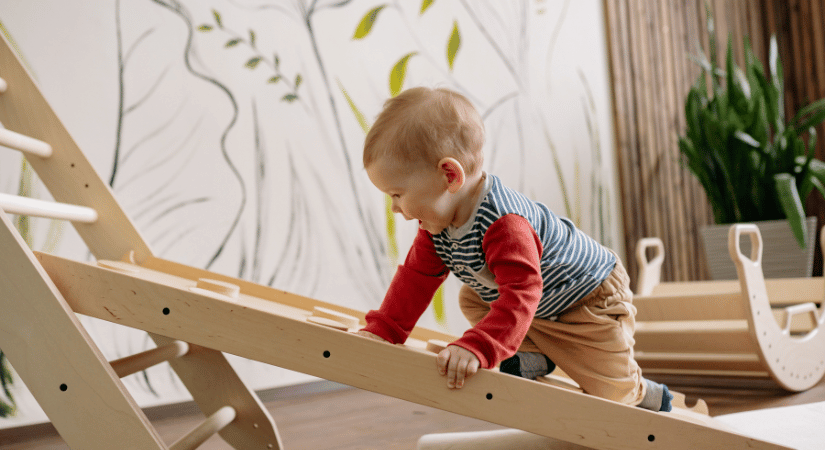
- Climbing: trees, climbing frames, or stacked crates. Start low and let children set their own height limit.
- Balancing: beams, logs, stepping stones, or a line of tyres. Vary the challenge as children’s confidence grows.
- Loose parts construction: give children crates, planks, and ropes and let them build. The creative problem-solving that emerges is significant.
- Forest school-style exploration: uneven terrain, natural materials, and independent movement away from adults. Our guide to nature-based activities for early years settings has ideas you can use directly.
- Water and mud play: buckets, pipes, ramps, and natural materials. Children learn physics, collaboration, and sensory tolerance. See our water play activity ideas for early years settings for specific ideas.
- Supervised tool use: woodworking benches with real, age-appropriate tools. The focus and pride children bring to this activity are unlike almost anything else in the early years environment.
Change the language you use during risky play
The words adults use during risky play shape whether children develop genuine risk literacy or simply learn to wait for adult permission before every decision.
Instead of “Be careful!”, try:
- “What is your plan for your next step?”
- “Do you feel stable there?”
- “What do you think will happen if you move your foot to that branch?”
- “How does that feel? Do you want to go higher or come down?”
These questions do not remove the challenge. They transfer the thinking to the child. That is the point of risky play: children are not simply learning to follow adult instructions about safety; they are developing their own judgement.
If a child is having difficulty, instead of intervening immediately, try:
- Pausing for three seconds before stepping in
- Positioning yourself nearby without hovering
- Asking rather than telling
Instead of “Good job!“, try:
- “You figured that out yourself.”
- “That looked tricky. What did you do when you nearly slipped?”
- “I noticed you stopped and thought before you jumped.”
- The language shift is not complicated, but it takes practice. It is worth building into staff supervision, team meetings, and reflective discussions.
How to practise risky play safely: the risk-benefit assessment
Risky play, in its nature, has some danger, so before you engage in this type of activity as a practitioner, you need to first be aware of what hazards can come up that push risky play from being a challenge into something potentially dangerous.
To strike this balance, you need to perform a risk-benefit assessment.
A risk-benefit assessment is not about eliminating risk. It is about weighing the developmental value of an activity against its potential for harm, then putting proportionate controls in place. This approach is recommended by Play England and widely accepted as evidence of good practice.
What a risk-benefit assessment covers
- Identify the activity and its benefits
Start with what children gain from the experience. Climbing a tree develops upper body strength, spatial awareness, confidence, and decision-making. That benefit is the starting point, not an afterthought.
- Assess the risks
What could go wrong, and how likely is it? A child falling from a low branch is possible. A child falling from an unsupported, rotting tree with no adult nearby is a different level of risk entirely. Be specific.
- Distinguish risks from hazards
This distinction is critical:
- A risk is a challenge children can encounter and learn from: uneven ground, a rope to balance on, or a log to jump from.
- A hazard is a hidden or uncontrolled danger that must be removed: broken equipment, unstable structures, or toxic materials.
- Put proportionate controls in place
Controls should be proportionate to the actual risk, not the imagined worst case. Supervising from a distance, setting clear boundaries, checking equipment weekly, and briefing children on expectations are all valid controls.
- Review regularly
Risk-benefit assessments are living documents. Review them when activities change, when you introduce new equipment, or when an incident occurs.
What this looks like in practice
| Activity | Benefit | Risk | Control |
| Climbing a tree | Balance, strength, spatial awareness | Falling from a height | Assess tree stability, set height limit, and position an adult nearby |
| Loose parts play | Creativity, problem-solving, and physical play | Tripping, pinching, splinters | Regular equipment check, age-appropriate materials |
| Water play | Sensory exploration, scientific thinking | Slipping, ingestion | Non-slip surfaces, adult supervision, water depth check |
| Woodworking with tools | Fine motor skills, focus, responsibility | Cuts, pinching | Age-appropriate tools, one-to-one or small group support, clear rules |
Building the culture: managing staff and parent anxiety
The practical side of risky play is relatively straightforward to establish on paper. The harder work is cultural: getting your whole team genuinely on board, and helping parents understand what they are seeing.
Supporting staff confidence
Practitioners who feel anxious about risky play often step in too quickly. This isn’t a criticism; it’s a natural response to perceived risk. The way to shift it is through shared understanding, reflection, and professional confidence.
Practical ways to support staff include:
- Talk about risky play in team meetings before introducing new activities. What do staff worry about? What do they need to feel confident?
- Observe together. Watching a child navigate a challenging climb and choosing not to intervene, then reflecting on what happened, is more powerful than any training session.
- Debrief after incidents. A grazed knee is not a failure. What matters is what the child did next, and whether the environment and supervision were appropriate.
- Use documentation as a professional tool. When staff record what they observe during risky play, they start to see the developmental story, not just the risk.
Building this professional confidence directly reduces workplace anxiety. For broader strategies on fostering a supportive working environment, see our article on supporting staff mental health in early years settings
Responding to parents
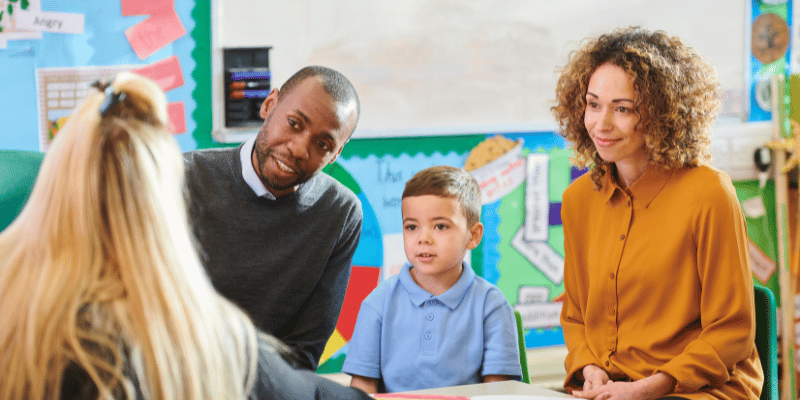
Parents who are anxious about risky play are not being unreasonable. They are responding to a culture that has, for decades, told them that safety means protection from all harm. Your job is to reframe that, gently and confidently.
When a parent says, “Why is my child’s knee grazed?”, this kind of response can help:
“We noticed [Child] was really testing their balance today on the logs, which is a huge physical milestone for them. They had a tiny stumble, but they got straight back up and solved the problem themselves. That kind of resilience is exactly what we are helping them build.”
This response does three things. It names what the child was doing developmentally, reframes the injury as part of the learning process, and reassures the parent that the adult was present and attentive.
Other practical steps for parent communication include:
- Share observations from risky play activities through your parent communication platform, with photos and brief developmental commentary.
- Include a short explanation of your risky play approach in your setting’s welcome pack or parent handbook.
- Reference research on adventurous play and children’s mental health when parents raise concerns.
- Invite parents to observe a risky play session if anxiety is significant.
For more on building strong parent relationships in your setting, see our guide to parent communication in early years settings.
The goal is not to win an argument. It is to bring parents into the developmental story so they become advocates rather than worried observers.
Why risky play matters: the developmental case
The evidence for risky play is not anecdotal. It is consistent, and it aligns directly with what the EYFS expects of high-quality early years provision.
Children need the freedom and time to play. Play is not a luxury. Play is a necessity.
Kay Redfield Jamison, Professor of Psychiatry at Johns Hopkins University School of Medicine, Exuberance: The Passion for Life (2004)
What the research tells us
The developmental benefits of risky play in early years are well established:
- Confidence: children learn what they can and cannot do through direct experience, not instruction.
- Emotional resilience: managing uncertainty, small setbacks, and physical discomfort builds coping skills that last.
- Physical development: coordination, balance, core strength, and gross motor skills all improve through active, challenging play. For more on this, see our article on the impact of physical development from a young age.
- Problem-solving: children assess a situation, make a decision, and adjust when something does not work.
- Risk literacy: children who encounter manageable risk develop a more accurate, less fearful understanding of danger.
- Independence: children learn to trust their own judgement and make choices without constant adult direction.
- Social development: activities such as rough and tumble play help children practise boundaries, consent, turn-taking, and self-regulation. Our article on the importance of personal, social and emotional development explores this area in more depth.
The EYFS link to risky play
Risky play is not a nice-to-have sitting outside the EYFS framework. It connects directly to statutory EYFS requirements across multiple areas of learning:
| EYFS Area | What risky play develops |
| Physical development | Gross motor skills, balance, coordination, and spatial awareness |
| Personal, social and emotional development | Self-regulation, confidence, resilience, and independence |
| Understanding the world | Exploring natural environments, materials, cause and effect |
| Communication and language | Children explain plans, negotiate rules, ask questions, and reflect on what happened |
Settings that document risky play well have clear, evidenced pathways to EYFS progress. Settings that avoid it often find gaps in their physical development and PSED observations that are difficult to fill in other ways.
For a broader view of how play connects to the seven areas of learning, our complete guide to the 7 areas of learning in EYFS is a useful reference.
The different types of risky play
Norwegian researcher Ellen Beate Hansen Sandseter, whose work is widely cited in early childhood education, identifies six categories of risky play. These map closely to what children naturally seek out when given the freedom to explore.
The six categories of risky play
| Category | What it looks like in practice |
| Play at height | Climbing trees, climbing frames, or raised surfaces |
| Play at speed | Running, cycling, sliding, or swinging fast |
| Play with tools | Using scissors, simple woodworking equipment, or garden tools |
| Play near elements | Engaging with water, mud, or supervised fire |
| Rough and tumble play | Play fighting, wrestling, or physical contact games |
| Exploring alone | Moving away from adults and navigating independently |
Each category serves a distinct developmental purpose:
- Play at height builds spatial awareness and balance.
- Rough and tumble play develops social skills, self-regulation, and boundary-setting.
- Exploring alone builds independence and decision-making.
- Play with tools supports focus, responsibility, and fine motor control.
- Play at speed helps children understand momentum, movement, and body control.
- Play near elements allows children to explore the natural world while learning respect for boundaries and supervision.
None of these categories are inherently dangerous when environments are well-managed and practitioners are observant. For more on how outdoor environments support these categories, our guide to the importance of outdoor play covers the foundations in detail.
Documenting risky play for EYFS and Ofsted
Observations from risky play are some of the richest evidence you can collect.
A child assessing whether a log is stable before stepping on it is demonstrating problem-solving, physical development, and self-regulation simultaneously. A child deciding whether to climb higher, pause, or come back down is showing confidence, judgement, communication, and emotional control.
Documenting these moments helps practitioners show that risky play is intentional, supervised, and developmentally valuable.
What effective risky play documentation includes
- A short written observation explaining what the child attempted
- A photo or video showing the activity
- Notes on the child’s decision-making, confidence, physical skills, or communication
- Links to relevant EYFS areas
- Any adult language or prompts used to support reflection
- A note on how the environment was managed safely
Using eylog makes it straightforward to capture these moments in real time, using photos, short videos, or written observations linked directly to EYFS areas. When an inspector asks for evidence of physical development or PSED, risky play observations are often the most compelling material a setting has.
Sharing those observations with parents through eylog also builds trust. When a parent can see a photo of their child confidently navigating a balance beam with a practitioner’s note explaining what it means developmentally, the grazed knee conversation becomes much simpler.
For more on getting the most from your observations, our guide to the importance of planning and observing in a childcare setting is a practical starting point.
Risky play FAQs
What is risky play?
Risky play refers to activities that involve challenge, excitement, uncertainty, or physical and emotional testing. It gives children the opportunity to explore what they can do, make decisions, and experience manageable risk in a supervised environment. It might include climbing, balancing, running fast, using tools, playing with water or mud, rough and tumble play, or moving slightly away from adults while still being safely supervised.
What ages is risky play suitable for?
Risky play can begin in early toddlerhood. Low-level challenges like climbing small steps, navigating uneven surfaces, or splashing in a shallow water tray are all appropriate starting points for children under two.
What is the role of the adult during risky play?
The adult’s role is to create a safe environment and then step back.
That means supervising from a distance rather than hovering, observing carefully, and intervening only when there is a genuine risk of significant harm.
How much risk is too much?
Risk becomes too great when hazards are present: broken equipment, unstable structures, toxic materials, or inadequate supervision for the activity.
The test is whether the child is in control of their actions and whether the environment has been assessed.
Does risky play increase the chance of injury?
Minor injuries, including grazes, bumps, and bruises, are more common in settings that embrace risky play. That is expected and appropriate.
What the research suggests is that children who encounter manageable risk regularly tend to develop better judgement, which can reduce the likelihood of more serious injury over time.
Support risky play with better documentation
Risky play is a key part of early childhood development. When it is managed thoughtfully, it gives children the space to build confidence, resilience, independence, and judgement in ways that structured activities simply cannot replicate.
The settings that do it well are not necessarily the ones with the most elaborate outdoor environments. They are the ones where staff understand why it matters, risk-benefit assessments are treated as professional tools rather than paperwork, and parents are brought into the developmental story rather than left to worry at the gate.
eylog helps settings document risky play efficiently and meaningfully. Real-time observations, photos, and videos link directly to EYFS areas, giving practitioners clear evidence of progress and giving parents a window into what their child is learning.
That documentation also gives you confidence in an Ofsted inspection, when you need to show that challenge and development are happening intentionally, not by accident.