

In brief
- British Values in the early years are not about politics; they’re about everyday life skills like turn-taking, listening, making choices, following routines, and respecting differences.
- There are four British Values in EYFS: democracy, the rule of law, individual liberty, and mutual respect and tolerance, which are closely linked to PSED and safeguarding.
- Ofsted expects to see these values embedded through your culture and practice, especially in inclusion, behaviour and routines, and leadership.
- Keep it simple: embed the values through play and daily routines, capture quick observations, and explain it clearly to parents using relatable examples and consistent language.
The phrase “British values” can raise questions in early years settings, especially from parents who associate it with politics rather than play, routines, and relationships. In reality, British Values in early years are about the everyday skills children need to feel safe, included, and confident.
It’s about the everyday moments that help children learn how to live alongside other people: taking turns, listening, making choices, following routines, and noticing that families can look different from their own. British values in early years settings are already happening in your practice. The key for 2026 is making them intentional, easy to evidence, and simple to explain to families, especially when someone asks, “Why are you teaching this to toddlers?”
Fundamental British values are also part of the safeguarding picture. Here’s everything you need to know about British values as an early years educator.
British values are a set of core principles introduced to help children understand fairness, respect, and community within a diverse society. In early years settings, they’re embedded through everyday practice rather than taught as standalone lessons. That matters because children learn values best through experience, not through what they’re told.
They also sit within the safeguarding context. The Prevent duty is part of the wider safeguarding approach, and it includes a focus on fundamental British values. The EYFS explicitly references the Prevent duty guidance, so it’s definitely something your setting needs to be aware of.
How many British values are there?
There are four fundamental British values:
- democracy: giving children a voice and helping them understand that their opinions matter in group decisions.
- the rule of law: supporting children to understand that rules keep people safe and that actions have consequences.
- individual liberty: encouraging children to make choices, explore interests, and develop confidence within safe boundaries.
- mutual respect and tolerance: teaching children to value others’ feelings, opinions, and differences, and appreciate other cultures, traditions, and ways of life.
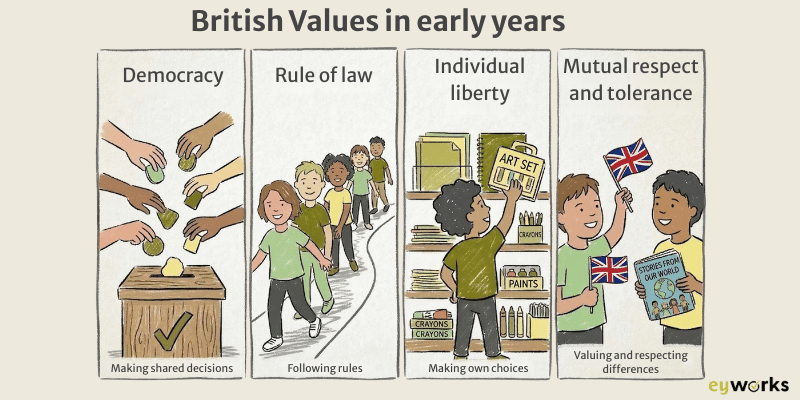
This four-value definition is consistently used in sector guidance, and it’s also reflected in current government guidance for early education and childcare.
You may sometimes see British values listed as five, with “mutual respect” and “tolerance of different faiths and beliefs” separated. In early years practice, these are intentionally combined. For young children, respect and tolerance develop together through everyday relationships, so EYFS guidance and inspection conversations usually refer to four Fundamental British values.
Why are the British values in EYFS important?
British values are woven into the EYFS because they support children’s personal, social, and emotional development, and help create safe, inclusive settings where children can thrive.
In practice, that looks like helping children:
- feel confident in who they are
- recognise and respect differences
- understand boundaries and expectations
- develop early empathy and problem-solving skills
Here are some specifics on why British values are important:
Fosters inclusivity
Promoting British values in early years helps children see difference as normal, positive, and interesting.
It supports inclusion when you:
- represent a range of families, cultures, languages, and beliefs in your books and resources
- model fairness in routines (who gets a turn, who gets helped first, how you share attention)
- create an environment where every child can join in, including children with SEND
This isn’t extra work. It’s the same inclusive practice you’re already doing, with clearer language around why it matters.
Builds safer communities
British values in EYFS are closely linked to safeguarding because they build children’s understanding of safety, boundaries, and trusted adults.
It helps children:
- understand that routines create safety
- learn what is “okay” and “not okay” through consistent expectations
- practise asking for help and recognising who can help them
Builds respect and tolerance
Respect and tolerance are not big concepts for later life. They start with small, repeated moments:
- hearing another child’s point of view
- noticing emotions and responding kindly
- repairing a friendship after a disagreement
- learning that different homes have different routines
Children don’t need lectures. They need language, modelling, and chances to practise.
Ofsted judges you on it
During an inspection, Ofsted are looking for demonstrations of British values being part of your setting. Ofsted does not expect a British values display or a folder of scripted activities. Inspectors want to understand how your setting works day to day, and whether children are safe, included, and supported to develop positive behaviour and attitudes.
From November 2025, the new Ofsted framework set out the evaluation areas for registered early years providers, including safeguarding, inclusion, behaviour, attitudes and establishing routines, and leadership and governance.
Even when inspection documents don’t always label British values as a standalone heading, the values show up clearly in what inspectors look for across these areas. The early years inspection toolkit also makes it clear that inspections focus on the impact of leaders’ systems and day-to-day practice.
Do you need to report on British values progress?
While nurseries aren’t required by law to produce a specific, standalone British values progress report for each child, this type of reporting helps show how children are developing socially and emotionally in line with these values.
Because these values closely align with the seven areas of learning, particularly Personal, Social and Emotional Development, evidence naturally appears within ongoing observations.
Tracking examples of decision making, respect, and understanding of rules provides a clear record of progress.
A practical approach that works for many settings:
- capture the moment (photo or short note)
- record the language the child used, where possible
- link it to what it shows (turn-taking, choice-making, empathy, boundary understanding)
- keep it brief, so it’s sustainable for the team
How to report to parents about British values in EYFS
Some parents feel uneasy when they hear the phrase “British values.” A few will worry it means politics, or that you’re pushing beliefs onto children. Reassure families with a calm, practical explanation. Here are some ideas:
- British values in early years are about how children learn to live together
- they focus on respect, fairness, choices, and rules that keep people safe
- they’re part of safeguarding expectations, not political teaching, and they’re embedded in everyday practice
Use relatable examples parents will recognise:
- “We practise turn taking, because it helps children understand fairness.”
- “We help children name feelings, because it supports empathy.”
- “We use consistent routines, because children feel safer when they know what to expect.”
Strengthening the home-nursery link
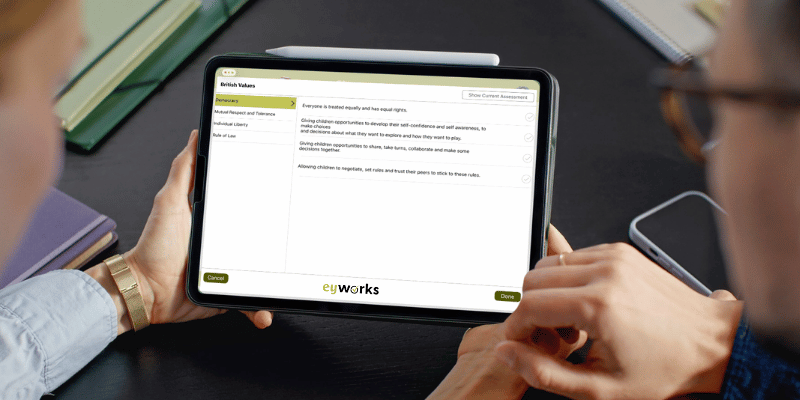
Meaningful parental engagement is key to embedding British values in your nursery culture. Using the free eyparent app, you can bridge the gap between your setting and home by sharing daily updates that highlight these values in action.
Whether it is a photo of a child making a democratic choice or a digital report signed by a parent, the app allows families to stay informed about their child’s social and emotional development. By making these interactions visible, you can reassure parents that British values are simply the everyday life skills that help us live well together.
Embedding British values in your nursery
For these digital updates to feel authentic to families, the values must first be lived by your team. Consistency is the foundation of a strong setting culture.
Start with your daily routine. Pick one everyday moment, like snack time, tidy-up, or outdoor transitions, and agree on the exact language the team will use to reinforce a value consistently. When adults use the same calm phrases, children learn faster, and evidence becomes easier to spot.
Promoting British values in early years builds confident, respectful, and socially aware children. By integrating them into play, routines, reporting, and parent communication, nurseries create environments that reflect fairness, safety, and inclusivity.
Discover how eyworks nursery management software can help you document progress, engage families, and support compliance.
While understanding the statutory “why” is vital for compliance, the real impact happens in the daily interactions between practitioners and children. To help your team move from theory to intentional practice, make sure to check our companion guide that covers 20+ practical activities to promote British values in early years.