

In brief
- Single-word grades have been replaced by nuanced report cards: Settings no longer receive binary labels such as ‘Outstanding’; instead, they receive colour-coded report cards with narrative explanations of strengths and priorities.
- The ‘Expected Standard’ is the new baseline for success: To achieve this baseline, a setting must meet every single criterion within an evaluation area, marking a shift from the previous ‘best fit’ model.
- Inclusion is now a mandatory, standalone evaluation area: Inspectors focus on how practice supports children with SEND and children experiencing disadvantage, and how this support contributes to their individual outcomes.
- The early years inspection has become more collaborative: The traditional ‘learning walk’ is replaced with a 30-minute planning call the day before the inspection.
From 10 November 2025, the way state schools, further education and skills providers, non-association independent schools and registered early years settings are inspected in England changed significantly. The biggest change is the shift from single-word “overall effectiveness” grades to a more nuanced, collaborative, and child-centred approach.
However, the gentler language and collaborative approach don’t change the fundamental reality that Ofsted inspections can impact your setting’s reputation, funding, and future viability.
This guide breaks down the new Ofsted framework for early years (2025), explains the new grading structure, and shares practical steps you can take to adapt your day‑to‑day practice with confidence.
Why the Ofsted inspection framework is changing
This change was introduced as a direct response to the “Big Listen” consultation, which received over 6,500 responses highlighting a lack of transparency and immense psychological pressure on staff.
For years, the sector has called for a reduction in the “accountability burden” and a reset of the relationship between Ofsted and the professionals they inspect. The tragedy involving headteacher Ruth Perry served as a final catalyst, forcing Ofsted to adopt a more empathetic and collaborative approach that prioritises professional dialogue over high-stakes binary labels, while upholding the statutory framework.
Three core ambitions drive the new approach:
- Putting children first: Ensuring every child, especially the most vulnerable, receives a high standard of education and care.
- Reducing burden: Removing the need for “mock” inspections or paperwork created solely for Ofsted.
- Increasing nuance: Moving away from blunt grades to provide parents with more detailed information about the inspection and a setting’s strengths.
Key highlights of the new framework
The Ofsted reform marks a shift from a simple “Pass/Fail” approach to a more detailed data report. To use a driving test analogy, under the old system, you either passed or failed. Now, you receive a detailed breakdown of your braking, acceleration, and awareness.
Video of the new Ofsted report card:
- No more single-word grades: The most significant change is replacing single-word grades such as “Outstanding” or “Inadequate” with more nuanced report cards. You will now see a colour-coded report card showing a setting’s performance across specific domains. The report will be accompanied by a narrative explanation of strengths and priorities for improvement.
- The “Expected Standard” is the goal: Meeting the Expected standard means you’re fully compliant and doing a great job; it is not a “middle” grade to be avoided.
- Collaborative Inspection: The inspector is there to validate your priorities and progress, not just to find faults.
Changes to the grading scale
Instead of the “Overall Effectiveness” grade, settings will now receive individual grades across several evaluation areas using a new five-point scale.
The five-point scale
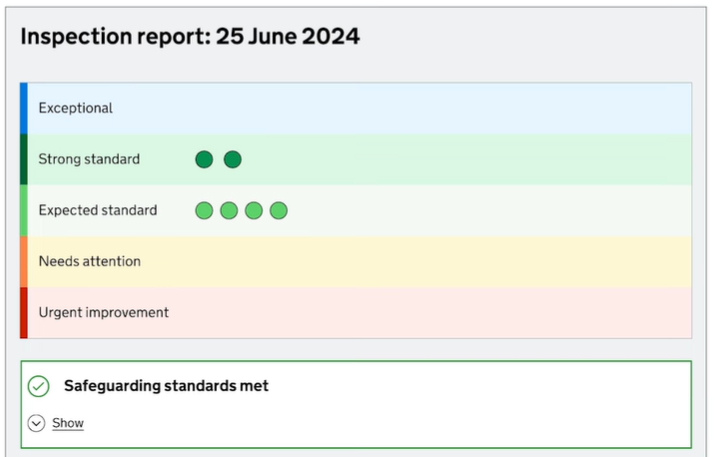
- Exceptional: Reserved for practice that is truly transformational and could be shared nationally.
- Strong Standard: For settings consistently exceeding requirements.
- Expected Standard: The baseline for inspection. This is the starting point, reflecting that the setting meets all EYFS requirements.
- Needs Attention: A positive but clear indicator that while things are being done, they are not yet a “secure fit” for the expected standard.
- Urgent Improvement: Applied when breaches to EYFS requirements significantly impact child safety or learning.
Important Note: Unlike the previous “best fit” model, the new framework uses a “secure fit” approach. To achieve the “Expected” or “Strong” standard, a setting must meet all the criteria in that column. This is a fundamental shift from the previous model, which granted inspectors the discretion to award a grade if a provider generally aligned with the overall description, even if some criteria were not fully met.
Revised evaluation areas
Ofsted has streamlined and realigned the evaluation areas to better align with the statutory Early Years Foundation Stage (EYFS) framework.
- Curriculum and teaching: Now a single, merged area evaluating educational design and daily interactions.
- Achievement: Focusing on child development and what children know and can do relative to their starting points.
- Behaviour, attitudes, and establishing routines: Observing how children engage and the environment practitioners create.
- Children’s welfare and wellbeing: Ensuring the holistic needs of the child are met.
- Leadership and governance: Including a new focus on how leaders support staff wellbeing and workload.
- Inclusion: A new mandatory area focusing on disadvantaged children and those with SEND. This will be a focus of every inspection, examining how settings break down barriers for disadvantaged children and those with SEND.
- Safeguarding: This remains a Met or Not Met judgment.
The new inspection experience
The “look and feel” of the inspection day is changing to be more collaborative.
The notification and planning calls
- Notification call: Will now happen before 10:00 AM on the day before the inspection.
- Planning call: This replaces the old “Learning Walk.” It is a conversation (usually around 30 minutes) later that same day where you discuss your context, curriculum overview, and priorities.
- Childminders: You will be notified of the specific day of your inspection within a five-day window, allowing you to plan around the children in your care.
The inspection day
- No more learning walks: Because this is covered in the planning call, inspectors will move straight into shared observations.
- Case sampling: Inspectors will track the experiences of a sample of children (particularly those with SEND or from disadvantaged backgrounds) to see the real-world impact of your practice.
- Professional dialogue: Leaders are encouraged to be alongside inspectors as much as possible, reflecting on evidence together throughout the day.
What the change means for early years settings
Here’s what the framework changes mean in practice:
- Your inclusion strategy is now make-or-break:
Inclusion is now a separate evaluation area, not buried within other judgments. You should be able to clearly articulate how you support disadvantaged children and those with SEND. It’s not enough to have policies; you have to demonstrate measurable impact on individual children’s outcomes. - “Expected Standard” is the new target:
The psychological shift is crucial: “Expected” isn’t mediocre; it means you’re doing exactly what you should be doing. But achieving it requires meeting all criteria in that column, not just most of them. This “secure fit” approach is less forgiving than the old “best fit” model. - The inspection conversation starts before the inspector arrives:
The “learning walk” is replaced by a 30-minute planning call (often via video) held the day before the visit to discuss context and improvement priorities. The planning call isn’t just logistics; it’s the beginning of your inspection. How you frame your context, challenges, and priorities in this conversation will shape everything that follows. Inspectors will conduct “case sampling” to track the lived experiences of specific children, particularly those from vulnerable groups. - The inspections are more frequent:
The routine cycle is reduced from six years to every four years. Newly registered providers will face their first inspection within 12 to 18 months, rather than 30.
Different perspectives
As the new education inspection framework takes shape, responses across the sector have been largely positive, with some important reservations.
Parents’ perspective
67% of parents prefer the new report card format to the old single-judgment format, according to an independent research done by YouGov.
Jason Elsom, Chief Executive of Parentkind, the UK’s largest parent charity, said:
“Ofsted has shown that it is listening to parents. When Sir Martyn Oliver became Chief Inspector, he promised reform – and today we are seeing Ofsted begin to deliver on that promise.”
Authority perspective
Ofsted maintains that the reforms offer nuance and reduce stigma while maintaining accountability. They argue the process is now “done with, not done to” the provider.
His Majesty’s Chief Inspector, Sir Martyn Oliver, said:
“Ofsted exists to keep children safe and improve their lives.
Children deserve the best possible education; their parents deserve the best possible information and education professionals deserve to have their work fairly assessed by experts. The changes we are presenting today aim to achieve all 3 of these things.
Our new report cards will give parents a clearer understanding of the strengths and areas for improvement at the places where their children learn. We will work with the professionals in schools, early years and further education to help them showcase the best of what they do – and help them identify where they can improve.”
Nursery perspective
While many welcome the end of single-word judgements, there is concern about the subjectivity of the “Exceptional” grade and the potential for “equity whiplash” in deprived areas. Nurseries also raise the risk of increased administrative burden that 40 sub-judgements could introduce.
Purnima Tanuku CBE, Executive Chair of NDNA, said:
“We have long campaigned for meaningful reform of how Ofsted inspects early years to ensure that the quality improvements we all want to see are the focus of how early years are regulated.
“This new inspection framework has the potential to inform and assure parents while working well for providers without being too burdensome. We welcome the fact that Ofsted has genuinely listened and acted on much of the feedback we have given on behalf of the early years sector.“
On the Inclusive Teach platform, a senior leader from the special school sector shared a cautious perspective:
“The shift feels like trading a sledgehammer for a Swiss Army knife: versatile, yes, but used poorly, it still isn’t effective.”
How to actually prepare (without doing anything extra)
The sector’s biggest mistake is creating an inspection theatre with special displays and rehearsed conversations, rather than embedding genuine, everyday quality practices that truly reflect the care and learning environment children experience every day. The new framework explicitly rejects this. Here’s what you should and shouldn’t be doing.
Stop doing these things immediately:
- Creating disconnected observation reports. Switch to an online learning platform built for the early years sector that captures and clearly reports children’s progress.
- Tracking internal data that serves no educational purpose
- Preparing staff scripts about what to say to inspectors
- Over-documenting routine interactions with children
Start doing these things instead:
- Train your team to talk confidently about individual children’s progress without notes.
- Develop a clear, evidence-backed narrative about how you support vulnerable children.
- Use your planning call strategically to highlight your strengths and contextualise any challenges.
- Focus your limited energy on the quality of daily interactions, not the documentation.
- Focus on day-to-day excellence.
- Review your inclusion strategy. Be prepared to clearly explain how you identify and support children facing barriers, whether these are socio-economic, SEND-related, or involve social care.
- Use the Ofsted explore an area tool to better understand your local context
- Use the Early Years Inspection Toolkit, Early Years Inspection Information, and Early Years Inspection Operating Guide for internal self-evaluation and auditing.
The technology test: If preparing for inspection requires creating new documents or reports, your systems aren’t working for you. The right tools should make your routine work visible and accessible without adding extra work when scrutiny arrives.
The technology question no one’s asking
Most early years providers are asking the same question: Does our nursery software support the new framework?
We believe you should be asking more strategic questions, such as:
- Can your system identify, track and report on SEND children separately? Inclusion is now a mandatory evaluation area. You need to demonstrate specific outcomes for these children, not just show they’re included in general data.
- Does your software help you identify and understand patterns in the progress of disadvantaged children over time? Inspectors will case-sample these children specifically. Your system should help you identify barriers and track interventions without manual analysis.
- Can you create and adapt curriculum pathways for individual SEND needs? Inspectors will want to see how your curriculum addresses diverse learning needs. Your system should allow you to design personalised learning journeys while maintaining clear progression tracking.
- Can staff access meaningful child information instantly during conversations? The planning call and inspector dialogue require confident, evidence-backed discussions about individual children, not fumbling through folders.
- Does your system reduce administrative burden or create it? If preparing for inspection requires generating new reports, your technology is working against you.
- Can you track staff wellbeing, development, and workload systematically? Leadership evaluation now includes how you support staff wellbeing.
The right technology makes the new framework easier to navigate, not harder. If it’s adding work rather than revealing insights, it’s time for a change.
Final thoughts
The renewed Ofsted framework marks a clear move towards greater transparency and collaboration. The introduction of detailed inspection report cards with narrative summaries means you can highlight the unique strengths of your setting. By focusing on meaningful day-to-day routines and using technology that supports and highlights the great work you do, you’ll find that the inspection process becomes less about ticking boxes and more about meaningful dialogue.