
Motor Skill Activities for Early Years: Practical Ideas to Support Development
Motor skill activities help children build strength, coordination, control, and confidence through play. In early years settings, the best activities support both fine motor skills (such as grasping, pinching, and mark-making) and gross motor skills (such as crawling, balancing, reaching, and climbing).
As the EYFS statutory framework makes clear, physical development is one of the prime areas of learning. That means motor skill activities are not optional extras. They are a core part of what settings are expected to plan for and observe.
For practitioners, the goal is not to rush children towards formal tasks. It is to provide meaningful, age-appropriate opportunities for movement, exploration, and repetition. That is what helps children build the physical foundations they need for everyday self-care, play, and later learning.
Here’s more insight on how to build motor skills development into your setting.
What are motor skill activities?
Motor skill activities are play-based experiences that help children develop control of their bodies. They support two distinct but connected areas of development: fine motor skills and gross motor skills.
As DfE guidance for early years providers confirms, fine motor development does not happen in isolation. Children need opportunities to build overall strength, coordination, and body awareness before smaller, more precise movements become consistent. Gross motor development always comes first.
That is why the strongest motor skill programmes in early years settings include both active movement and smaller focused tasks, planned across the day and the environment.
Fine motor skills vs gross motor skills: what is the difference?
Understanding the difference helps practitioners plan a more balanced approach.
|
Skill type
|
What it involves
|
Examples in early years
|
|
Fine motor
|
Small movements using hands, fingers, and wrists | Grasping, pinching, threading, mark-making, using tools |
|
Gross motor
|
Larger whole-body movements using arms, legs, and core | Crawling, climbing, balancing, jumping, pushing, reaching |
Fine motor skills are needed for tasks such as holding objects, turning pages, stacking, and mark-making. Gross motor skills underpin larger movements: rolling, crawling, climbing, and balancing.
The two are closely connected. A child needs shoulder stability, core strength, and body control before they can develop more refined hand movements. That means activities which build whole-body confidence and coordination are just as important as the smaller, more focused tasks practitioners often associate with motor skill development.
Why are motor skill activities important in early years?
Motor skill development supports much more than physical movement. It helps children take part in everyday routines and become more independent. As we explore in our guide to the impact of physical development from a young age, physical activity and development are closely linked to cognitive growth, emotional wellbeing, and long-term health.
Strong motor development can support:
- feeding and using utensils independently
- dressing, including zips, buttons, and fastenings
- mark-making and early writing readiness
- hand-eye coordination
- balance and spatial awareness
- confidence in play and exploration
For practitioners, motor skill activities also create rich observation opportunities. You can often spot progress in grip, coordination, bilateral movement, concentration, and persistence through everyday play. Those observations are what make planning more responsive and more personal.
10 motor skill activities for early years settings
Here are 10 practical motor skill activities you can use in nursery and early years environments. Each one is low-cost, adaptable, and linked to clear developmental benefits.
1. Treasure basket exploration
Fill a basket with safe everyday objects in different textures, sizes, and shapes, and prompt the children to interact with them. Things like natural materials, wooden spoons, fabric, and textured balls all work well.
Supports: Grasping and releasing, sensory exploration, reaching, and transferring objects between hands.
2. Tummy time and floor play
For younger children, tummy time and open floor play are essential building blocks for motor development. These early gross motor experiences create the foundation for later fine motor control.
Supports: Shoulder and neck strength, core stability, reaching, and pushing up.
3. Posting and container play
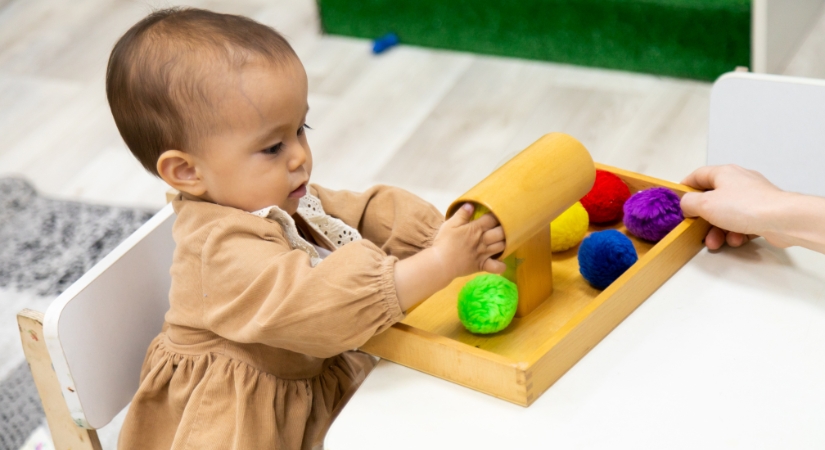
Provide objects that children can post into boxes, tubes, or containers. Use large pompoms, blocks, lids, or other safe loose parts appropriate to the child’s stage.
Supports: Hand-eye coordination, controlled release, problem-solving, and fine motor precision.
4. Water play with scoops and sponges
Water play is excellent for both fine and gross motor development when children are squeezing, pouring, stirring, and transferring. We have a full set of water play activity ideas for early years settings if you want more inspiration.
Supports: Hand strength, wrist control, bilateral coordination, and sensory engagement.
5. Stacking and nesting toys
Cups, soft blocks, and stacking rings are simple but effective. The trial-and-error nature of stacking builds persistence alongside coordination.
Supports: Grasp and release, visual tracking, and problem-solving.
6. Mark-making with different tools
Offer chunky crayons, brushes, chalk, rollers, or fingers with paint, foam, or sand. Mark-making should feel exploratory, not pressured. It is one of the most natural bridges between motor skill development and early literacy.
Supports: Hand strength, grip development, shoulder movement, and early writing readiness.
7. Playdough and malleable materials
Playdough, clay, or soft putty give children chances to squeeze, pinch, roll, and poke. This is one of the most effective fine motor skill activities available in any setting, at any age.
Supports: Finger strength, pincer development, hand endurance, and sensory exploration.
8. Action songs and finger rhymes
Songs with actions, clapping patterns, and finger movements are easy to build into the day and need no equipment. The importance of singing and music in early years extends well beyond language development, and these movements can help motor skill development.
Supports: rhythm and coordination, finger isolation, listening, imitation, and bilateral movement.
9. Outdoor obstacle courses
Simple obstacle courses indoors or outdoors can include crawling tunnels, stepping stones, cushions, or low climbing equipment. Outdoor play is one of the most underused environments for gross motor development.
Supports: balance, coordination, core strength, and spatial awareness.
10. Everyday self-care and routine tasks
Some of the best motor skill activities are already part of the day. Helping with snack preparation, pouring drinks, carrying small items, tidying resources, and using child-safe tools are all meaningful, motivating, and closely linked to independence.
Supports: bilateral coordination, grip, hand-eye coordination, and self-care skills.
How do you choose the right motor skill activities?
The best motor skill activities match the child’s stage of development, not just their age.
As a general guide for practitioners:
- start with larger movements before expecting precise hand control
- choose open-ended activities with no single “right” outcome
- make tasks meaningful and engaging to the child
- use repetition without making the play feel repetitive
- adapt resources where needed to help children succeed
It is also worth watching how a child approaches an activity. Are they using one hand or both? Can they reach, grasp, release, and manipulate objects comfortably? Are they avoiding certain movements? Those small observations often tell you more than the finished result.
That is why planning and observing go hand in hand with motor skill activities. What you notice during play is what makes your next steps meaningful.
How eyworks supports motor skill tracking and development
Planning motor skill activities is only part of the picture. Practitioners also need a clear way to record what they are seeing, track progress over time, and share meaningful updates with families.
That is where eyworks can help. Our online learning journals make it straightforward for practitioners to capture observations linked to physical development, including photos, videos, and written notes, all in one place.
With eyworks, settings can:
- Record observations linked to physical development as they happen, on any device
- Map progress against established frameworks, including EYFS, Development Matters, and the British Values.
- Identify patterns in a child’s development over time, including areas where extra support may be needed.
- Share updates with families through the parent app, so parents and carers can see and contribute to their child’s learning journey.
- Reduce admin by replacing paper-based records with a structured digital system.
For busy settings, this matters. It saves time, improves visibility across the team, and supports more confident decision-making. Rather than relying on memory or scattered notes, practitioners have a clear record they can return to, build on, and share.
Consistent, well-recorded observations are what turn a good motor skill activity into a meaningful part of a child’s developmental story.
If you want to see how eyworks can help your setting track physical development more effectively, book a free demo and we’ll show you how it works in practice.
Supporting development with confidence
Motor skill activities sit at the heart of early years practice. When they are thoughtfully planned, regularly observed, and adapted to each child, they do far more than support movement. They build independence, confidence, and the foundations for future learning.
For practitioners, the real impact comes from consistency. Creating opportunities for movement across the day, noticing how children engage, and using those observations to guide next steps is what turns everyday play into meaningful development.
This is where having the right tools in place makes a difference. Being able to quickly capture observations, track progress over time, and share insights with families allows your team to focus less on paperwork and more on what matters, supporting each child’s development.
If you want a clearer, more efficient way to manage observations and track physical development across your setting, take a closer look at how eyworks can support you. Book a free demo or explore our nursery management software to see how it works in practice.